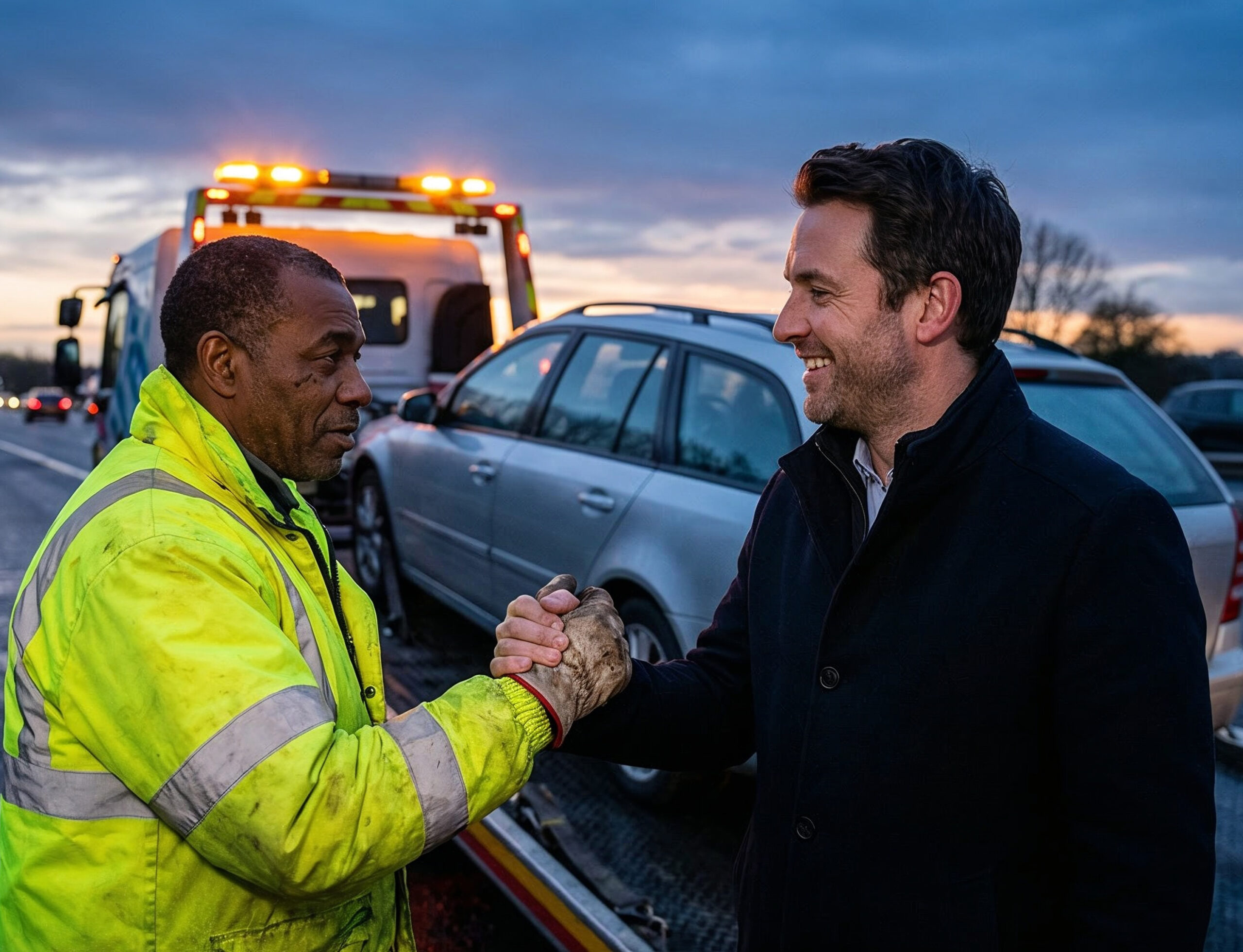
Sineaid McLaughlin and Iain Service launched Kaiser Recovery just nine months ago and business is going well. Previous to that, both had worked for well-known and respected businesses in the recovery and transport industry, including employment with the bigger clubs. These experiences demonstrated the importance of networking and building relationships, as well as how Apex RMS played a crucial role in connecting recovery operators with the wider network.
Sineaid and Iain believed that accurate and industry-bespoke software, along with a fool-proof means of storing important business information, was instrumental to success. Sineaid had used Apex RMS whilst working in other recovery businesses, and describes herself as a fan. She knew it would run their business efficiently, serve their clients and employees well, and keep the organisation of Kaiser Recovery streamlined, reliable and agile.
A new business needs trained and reliable employees, suitable premises and a comprehensive business system that runs smoothly. With extensive industry experience, both partners understood their potential pain points: good communication with the clubs; employing experienced drivers capable of training up new ones; and facing the fact that they were now 100% in charge, and no two days would ever be the same.
But they also had two things were definitely in their favour: great respect from drivers they had worked with previously (some of whom joined Kaiser Recovery from the start) and their decision to use Apex RMS.


Right from the start, Apex RMS became the backbone of Kaiser Recovery’s accurate and efficient organisation. As Director of Operations, Sineaid in particular knew the software well. They agreed it would be a must for communication, accurate storage of data and documents, as well as efficient overall management. “Our aim and expectation was growth,” Sineaid explains. “That’s why we made the decision to miss out on RMS light from the start.”
One issue to keep as ‘tight’ as possible was the use of video, and this was very important to them in preventing disputes. “Whenever we’re on a scene, the drivers take a video straightaway, and also when they drop,” Sineaid explains. “Sometimes that’s better than images. If anyone says “that scratch wasn’t there” then we have the proof that it was, and it stops any further hassle.”
The Clubs
Working seamlessly with the Clubs is vital, and Kaiser Recovery believe that the ability to receive a job and deploy it quickly to a driver is one of the biggest benefits of Apex RMS. It also minimises the time spent by drivers on jobs, which in turn maximises income. “Once you open that job, you’re looking to see who’s best to take it,” Sineaid explains. “With Apex RMS there’s no ‘strange’ handwriting to decipher, or hard to understand texts. The screen displays exactly who is available, and when.”
Another plus is the use of PDAs. Whilst this can involve extensive training, all new drivers begin their learning curve paired with an experienced colleague, who demonstrates how to take those important pictures and videos and gain experience. To ensure they are fully competent, ‘dummy jobs’ are invented to practise following the right procedures. “Getting the most out of your drivers maximises income,” Sineaid explains. “We train them to assess the scene and consider risks before they even get out of the cab, which means a better outcome for all.”
Kaiser Recovery hit the ground running. With new trucks on the road and a fleet of well-trained drivers it has been growing ever since. “Taking on full RMS from the start has been to our benefit,” says Sineaid. “I’ve always been an advocate. It’s a great tool, I enjoy working with it, and things are going really well.”
Accurate organisation is vital for management, and Apex RMS gives Sineaid exactly what she needs: “I know where I can find things, it’s great for invoicing and even if you’re not technologically savvy, it is so user friendly,” Sineaid explains. “And you can’t mess it up – because anything can be reversed.”
Sineaid understands that using Apex RMS it can be daunting at first. She suggests using it for basic jobs at first, or simply running your accounts and building from there. “As your confidence grows, you try out other functions, and the support guys at Apex are great if you have a question.”
What would Kaiser Recovery advise a new user to try out first? “Being able to receive and accept jobs from the clubs and dispatch them quickly to drivers,” she says emphatically. “It’s all on the screen, avoids inaccurate notes, gets efficiency from your drivers and generates more income.”
Tracking
Sineaid and Ian find that Apex RMS reduces the time between accepting and completing a job from the clubs. Trackers mean you can check the recovery vehicle location and update those who are waiting, as well as note if a truck has stopped somewhere unscheduled.
Great to give peace of mind that help is nearly there, or alert to a delay due to traffic. “Taking control of the job, after making that initial contact, is important,” says Sineaid. “You’ve removed the middle man, and those stranded can contact you directly. You can also give them updates. Reassurance is important, especially if they are on their own.”
Training
When we take on a new driver, we show them the basics and then pair them with one experienced with Apex RMS. When they are out together, the new driver gradually takes on the communication which means they are as well prepared as possible when they go out alone. We also advise them to take a moment in their cab on arrival to risk assess the specific situation for example, how to load the vehicle and any damage. Videos and photos are essential. Allianz, for example, require a video on collection. But it is good practice that ensures we have proof of when any scratches or damage occurred.
Future
Kaiser Recovery are already considering using Apex RMS for workshop. This means that each time a vehicle requires workshop, they could take it to their own internal facility. The software would also allow a smooth flow from actual recovery to the vehicle being repaired and ready. “It would tie it all up nicely,” says Sineaid. “So much to do first, but it will be worth it.”
Any Final thoughts?
Consider an Apex Training Day. There’s always something you can learn that will save time and give more accuracy in the long run.
Qu: What would you keep from the software if you were only allowed one thing?
Ans: That’s a tough question. I want it all!